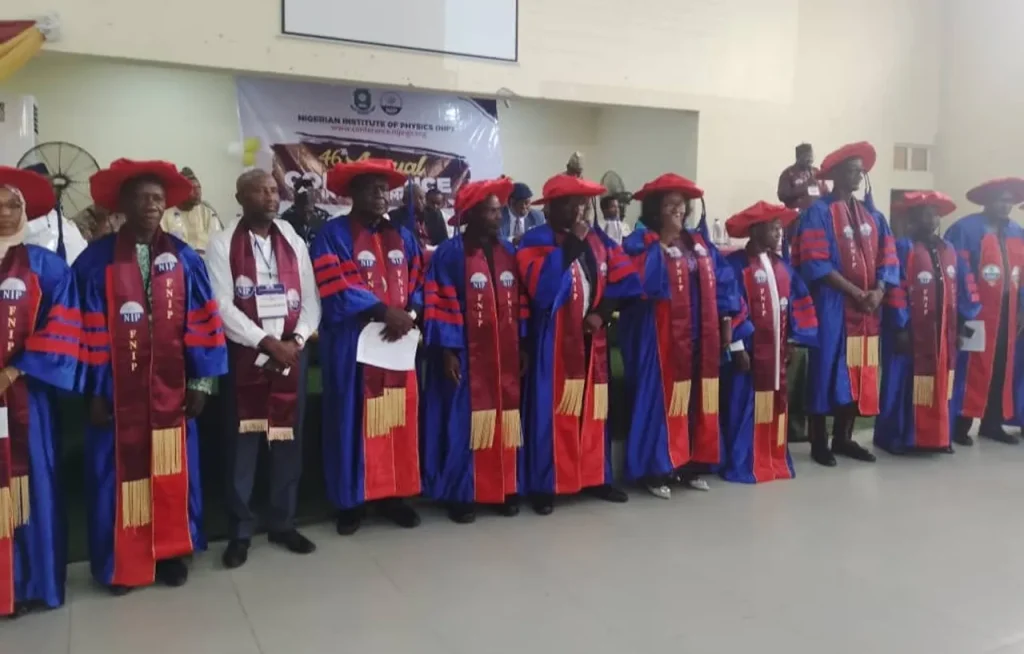
The Nigerian Institute of Physics (NIP) successfully held its 46th Annual Conference from the 12th to 16th of May, 2025, at Rivers State University, Port Harcourt. The Conference, with the theme “Physics in the Quadruple Helix Model for Innovative Research and Economic Development”, brought together physicists, researchers, policymakers, academics, industry experts, and stakeholders from across the country.
The Conference was declared open by the Vice-Chancellor of Rivers State University, Prof. Isaac Zeb-Obipi, who welcomed delegates and emphasized the pivotal role of Physics in national development. He expressed confidence that the outcomes of the Conference would be of immense benefit to the University, the scientific community, and the nation.
In his opening remarks, the National President and Chairman of NIP, Prof. J. O. Coker, described Physics as the bedrock of all scientific and technological advancement. He urged both State and Federal Governments to strengthen Physics education and research through institutional support and increased investment.
The keynote speaker was Mr. Khalil Suleiman Halilu, Executive Vice Chairman and CEO of the National Agency for Science and Engineering Infrastructure (NASENI), he was ably represented by Prof. Umar Gaya. The speaker emphasized the importance of the Quadruple Helix Model — involving Academia, Industry, Government, and Civil Society — as a strategic framework for fostering innovation and economic growth. It highlighted the integration of Physics-based research into priority sectors such as renewable energy, healthcare, manufacturing, and artificial intelligence, as vital to Nigeria’s transformation into a knowledge-driven economy.
Prof. Gaya, representing NASENI, further noted the Agency’s efforts in funding Physics-driven research, establishing centers of excellence, and promoting community-based innovation, including initiatives supporting women in science and engineering. He emphasized that collaborative synergy between academia and industry is essential for translating research into tangible societal benefits.
Plenary sessions during the Conference featured insightful presentations, given by well bred scholars, including:
1.Dr. Ferdinand Giadom, who delivered a paper on “The Challenges of Global Warming and Its Dire Implications on the Nigerian Economy”.
2.Dr. Daere Akobo, represented by Prof. Ifenyiwa Achumba, who also addressed the topic “The Challenges of Global Warming and Its Dire Implications on the Nigerian Economy”, offering complementary perspectives.
3.Dr. Jonathan Iworiso, who joined virtually from the United Kingdom, and presented on “Econophysics: An Enhancement Tool in Economic Processes”, exploring the interface between physics principles and economic modeling.
Technical sessions, and discussions provided a dynamic platform for sharing scientific knowledge, fostering collaboration, and addressing national challenges through Physics.
At the end of the Conference, the following key resolutions were adopted:
1.Strengthening Physics Education: The Conference called for renewed government commitment to the advancement of Physics education through improved curricula, enhanced infrastructure, and continuous teacher development.
2.Operationalizing the Quadruple Helix Model: Participants urged stakeholders to institutionalize collaboration among academia, industry, government, and civil society to foster innovation and address socio-economic challenges.
3.Increased Funding for Research: Delegates emphasized the urgent need for robust and sustained funding for Physics-based research, particularly in frontier areas that impact national development.
4.Establishment of Innovation Hubs: The Institute advocated the creation of Physics-based innovation hubs and research clusters to enhance the application of scientific knowledge to real-world problems.
5.Policy Support and Legislative Frameworks: The Conference called on government to enact science and technology policies that promote private-sector participation and incentivize investment in research and innovation.
6.Promotion of Inclusivity in Science: Emphasis was placed on supporting inclusive research models that encourage the participation of underrepresented groups, including women, youths, and rural communities.
7.Empowerment of the Nigerian Institute of Physics: The Institute should be strengthened as a key stakeholder in national science policy formulation and implementation, and positioned to provide expert guidance on Physics and its applications in national development.
The Nigerian Institute of Physics expresses profound appreciation to the management of Rivers State University for their warm hospitality and support in hosting the Conference, and to all delegates, speakers, sponsors and stakeholders for their active participation and contributions.
Issued this 16th day of May, 2025, at Port Harcourt, Rivers State.
Signed:
Prof. Godfrey Akpojotor
Public Relations Officer
Nigerian Institute of Physics (NIP)